 Skip to main content
Skip to footer
Skip to main content
Skip to footer

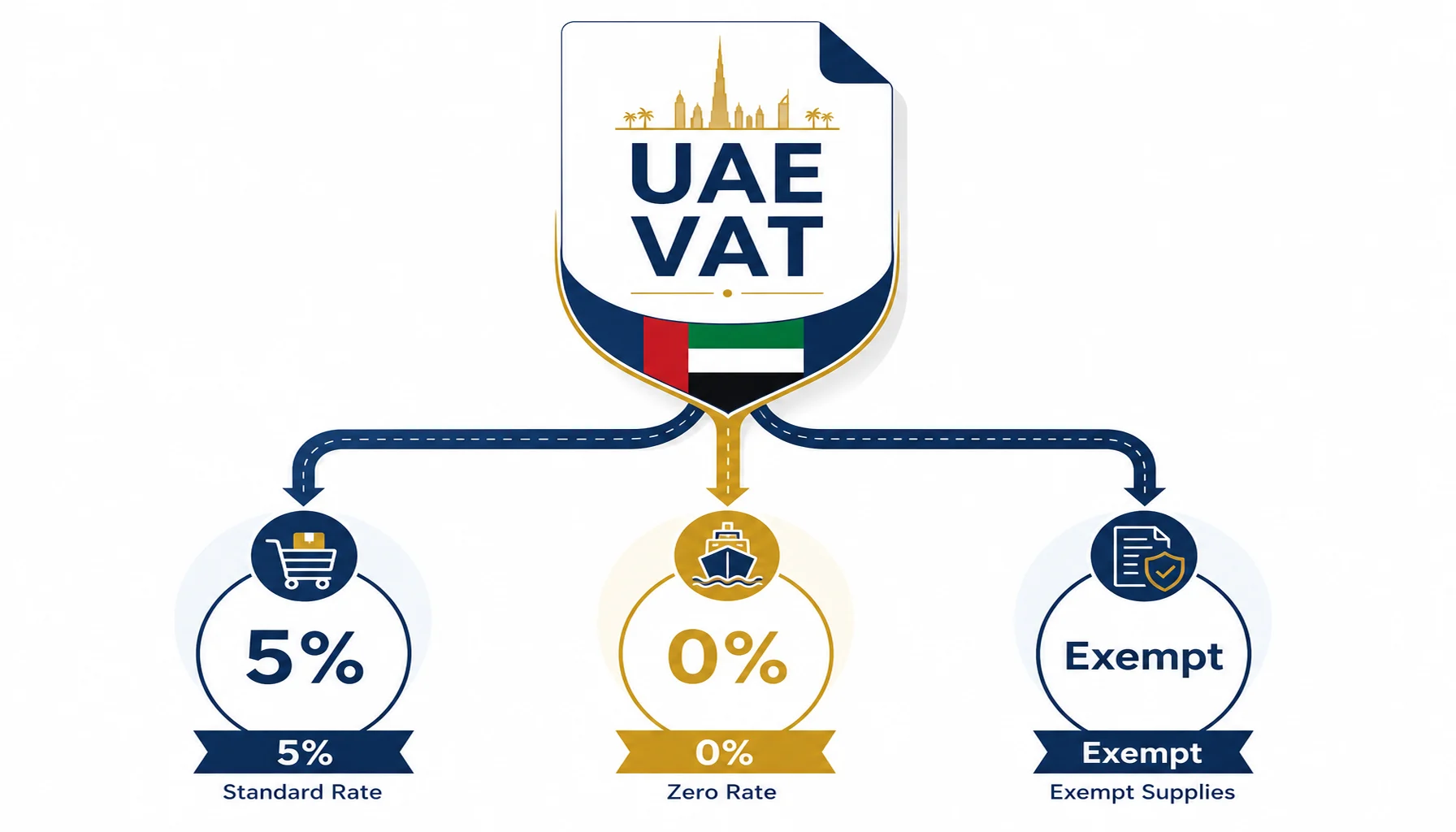
UAE VAT has three possible outcomes for a supply, not two. Most goods and services are standard-rated at 5%. Some are zero-rated at 0%. Others are exempt.
Zero-rated and exempt both mean no VAT is charged on the sale, which is exactly why people mix them up, but they affect input tax recovery in completely different ways. That difference has a real cash impact on a business. Getting the classification right from the first return is where our VAT accounting services in the UAE can add the most value.
The Standard Rate: 5%
Most goods and services supplied in the UAE are standard-rated, which means VAT is charged at 5% on the sale, collected from the customer, and remitted to the Federal Tax Authority. This is the default category. Unless a supply specifically qualifies as zero-rated or exempt under the VAT Law, it is standard-rated.
Zero-Rated Supplies: 0% Charged, Input Tax Still Recoverable
Zero-rated supplies are charged at 0%, so the customer pays no VAT on that transaction. The important point is that a business making zero-rated supplies can still recover the input VAT it paid on related purchases and expenses. That is the key difference from exempt supplies below.
Categories that are typically zero-rated in the UAE include:
- Exports of goods and services outside the UAE, and certain services supplied to non-residents
- International transport of passengers and goods, and related services
- Certain healthcare services and related goods, where specific conditions in the VAT Law are met
- Certain education services and related goods, again subject to specific qualifying conditions
- The first supply of new residential buildings, within a set period of completion
- Investment-grade precious metals meeting defined purity and tradability conditions
- Crude oil and natural gas
The word “certain” matters throughout this list. Healthcare and education, in particular, are zero-rated only where the specific supply meets the conditions in the VAT Law and related executive regulations, not as a blanket rule for anything labelled medical or educational. The Federal Tax Authority publishes sector-specific guides, including one dedicated to education, because the boundary is easy to get wrong.
Exempt Supplies: No VAT Charged, Input Tax NOT Recoverable
Exempt supplies also carry no VAT, but here the business generally cannot recover input VAT on purchases related to making those exempt supplies. That is the opposite of zero-rated treatment, which is why the distinction matters so much.
Categories that are typically exempt include:
- Certain financial services, specifically those earning a margin-based or implicit fee rather than an explicit fee, such as certain lending and account services
- Residential leases, after the first supply of a new residential building has already used its zero-rated window
- Bare (undeveloped) land
- Local passenger transport, such as licensed taxis and public transport
A business that makes only exempt supplies, and no taxable supplies at all, generally cannot recover VAT on its costs and may not even be able to register for VAT if it never crosses the taxable supplies threshold, since exempt supplies do not count toward that threshold. See our UAE VAT registration threshold guide for how taxable supplies, which exclude exempt supplies, drive the registration requirement.
Why the Difference Between Zero-Rated and Exempt Actually Matters
Two businesses can both charge 0% VAT on a sale and still end up in very different financial positions. A zero-rated exporter recovers the VAT it paid on stock, packaging, and shipping costs, which puts that activity in a refund position. A business making only exempt supplies pays VAT on its costs like any consumer would, with no mechanism to claim it back against those exempt sales.
If your business has a mix of standard-rated, zero-rated, and exempt activities, input tax usually needs to be apportioned between them, since only the portion related to taxable supplies is recoverable. Getting that apportionment right from the first period, rather than correcting it retrospectively, is exactly what a specialist handles before a business’s first VAT return lands.
When Input Tax Needs to Be Apportioned
A business making only standard-rated and zero-rated supplies generally recovers all of its input VAT, since both count as taxable supplies. Once exempt supplies enter the mix, alongside standard-rated or zero-rated ones, input VAT on costs that serve both types of activity cannot simply be claimed in full.
It needs to be apportioned between the recoverable and non-recoverable portions, using a standard method based on the ratio of taxable to total supplies, or, for businesses where that standard method does not fairly reflect actual use, a special apportionment method agreed with the Federal Tax Authority. The FTA publishes a dedicated guide on special apportionment methods for exactly this situation. Getting this allocation wrong in either direction, over-claiming or under-claiming, is one of the more common findings in a VAT review for businesses with a mixed supply profile, such as those combining retail sales with exempt residential leasing income.
Frequently Asked Questions
If my product is zero-rated, do I still need to register for VAT?
Zero-rated supplies count as taxable supplies for the purpose of the registration threshold, even though the VAT charged is 0%. Crossing the AED 375,000 mandatory threshold on zero-rated sales alone still creates a registration requirement.
Is exporting goods automatically zero-rated?
Exports of goods outside the UAE are generally zero-rated, but specific conditions around documentation and delivery terms need to be met to support the zero-rating on a VAT return. Missing documentation can result in the FTA treating a sale as standard-rated instead.
Can a business be both VAT-registered and only make exempt supplies?
It is uncommon, since exempt supplies do not count toward the registration threshold and do not require registration on their own. A business making a mix of exempt and taxable supplies would register based on its taxable supply value and would then need to apportion input tax between the two categories.
Are digital and online sales automatically standard-rated?
Generally yes, unless the specific product or service qualifies for zero-rating or exemption on its own merits (education content meeting specific conditions, for example). Speak with a VAT specialist if you need this assessed for a specific online business model.
This article explains general UAE VAT rate categories and is not a classification of any specific product or service. Zero-rated and exempt treatment depends on conditions set out in the VAT Law and its executive regulations. Speak with our team — VAT service providers in the UAE — to confirm how a specific supply is treated.
